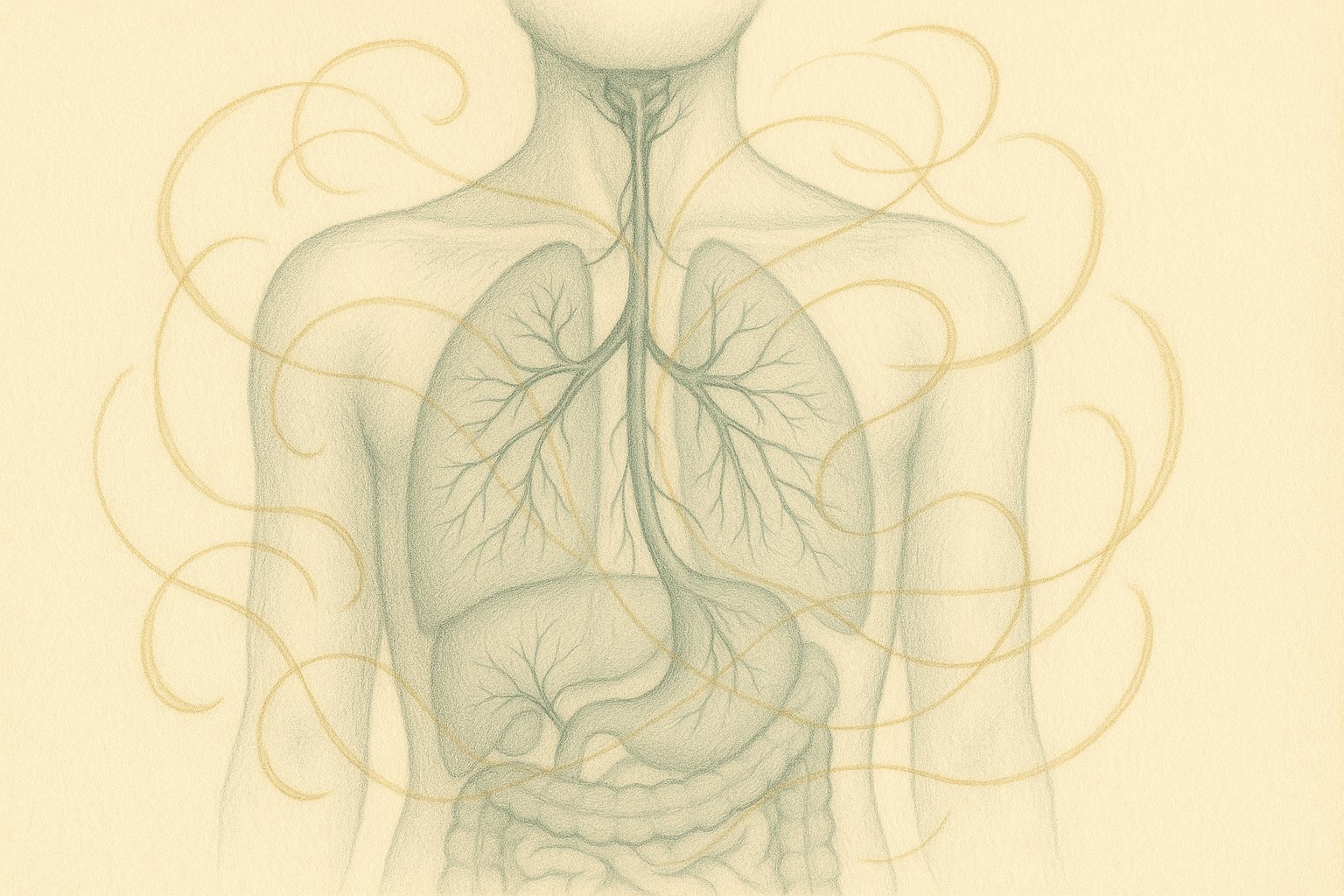
For decades, traditional psychotherapy has rested on an implicit assumption: understanding what dwells within us is enough to transform it. But a growing number of people who spend years in talk therapy are reaching the same conclusion — some patterns resist change, no matter how many times they are named, analyzed, or recontextualized.
This is not a failure of speech. It is often a sign that the emotion in question is stored elsewhere — in the tissue, in the breath, in the autonomic nervous system — where words do not arrive directly.
Why emotions live in the body
When an emotion is fully felt and integrated, it passes through the body and goes. But when it arises at a moment deemed dangerous or overwhelming, the body retains what the mind cannot process.
This process has a name: somatic memory. Researcher Bessel van der Kolk helped formalize it in his work on trauma (The Body Keeps the Score, 2014). Stephen Porges, with his Polyvagal Theory (2011), showed how the autonomic nervous system constantly modulates the body's state of safety or threat well outside of rational consciousness.
In concrete terms, an unprocessed emotion manifests in several physical forms: chronic muscle tension, rigid fascia, shallow and restricted breathing, persistent low-grade inflammation, and dysregulation of the autonomic nervous system. These are not metaphors. These are measures.
Where specific emotions are held
Chinese medicine mapped the emotional anatomy of the body 2,500 years ago. What modern somatic research observes today corresponds, remarkably, to these ancient maps.
| Anger · Frustration | Liver, jaw, shoulders, upper back — often expressed as clenched hands or chronic tension in the neck. |
| Sorrow · Sadness | Lungs, chest, upper body — shallow breathing, collapsed posture, sensation of heaviness in the chest. |
| Fear · Trauma | Kidneys, lower back, pelvis, sacrum — tension in the legs and pelvic floor. |
| Worry · Rumination | Stomach, intestines, digestion — a direct connection to functional digestive disorders. |
| Emotional shock | Heart — palpitations, anxiety, the sensation of having been struck in the chest. |
| Ancestral grief | Diaphragm and breath itself — breathing as an archive of transgenerational unspoken truths. |
These correspondences are not arbitrary. They reflect how the autonomic nervous system routes emotional activation through the viscera — via the vagus nerve, enteric connections, and the fascial chains that link the throat to the perineum.
How to know if you are carrying a stored emotion
Certain signals indicate that the body is holding something the mind has not yet been able to integrate.
- Persistent tension in a specific body region, without an identifiable mechanical cause
- A sense of disconnection from the body, even at rest
- Emotional reactions that feel disproportionate to what is actually happening
- Chronic digestive problems without a clear medical explanation
- Sleep disturbed by recurring intrusive thoughts
- A constant sense of being on edge — a body that cannot fully let go
- Shallow, restricted, or irregular breathing, particularly noticeable under stress
- Relational or emotional patterns that repeat themselves despite sustained therapeutic work
That last signal deserves attention. When the same situations generate the same reactions, again and again, it is often because the source is not cognitive — it is somatic.
Why understanding alone is not always enough
Emotion processing uses two distinct pathways in the nervous system. Confusing them — or activating only one — explains many therapeutic blockages.
Language & understanding
Cognitive reformulation. The territory of verbal psychotherapy — effective for what can be thought and named.
Body & nervous system
Breath, fascia, somatic experience. Where chronic patterns and deep trauma reside — inaccessible through words alone.
When emotion is stored at the somatic level, reaching it requires intervention at the same level. You cannot reason a nervous system out of learned tension — it is an automated survival mechanism. The body needs an experience of safety, not an explanation.
How acupuncture releases stored emotion
Acupuncture acts directly on the pathways where emotions are held.
-
Vagal regulation
By activating parasympathetic tone, acupuncture shifts the nervous system out of sympathetic vigilance into a state of physiological safety — the condition in which the body can finally release what it has been holding.
-
Fascial release
The needles release tension in the connective tissue — the network that runs throughout the body and keeps emotional patterns in place. Spontaneous emotional shifts often occur during or just after treatment.
-
Work on the organ meridians
In Chinese medicine, each organ is associated with a specific emotional dynamic: the liver for anger, the lungs for grief, the kidneys for fear. Circulating Qi through these meridians moves stored emotion back toward its source.
-
Breath restoration
The natural deepening of breathing during a session is one of the first signs that stored emotion is beginning to release. The diaphragm, often rigid, regains its range of motion.
"Crying without knowing why — and feeling relieved afterwards."
"Something has finally moved, after being stuck for years."
"I slept like I hadn't slept in a long time."
These experiences are not random. They correspond precisely to what somatic neurobiology predicts when the nervous system finds a sufficient window of safety to metabolize what it was carrying.
The body is a memory system. What it has retained can be released — not by reliving it, not by analyzing it endlessly, but by creating the physiological conditions in which letting go becomes possible.
This is what acupuncture has been doing for 2,500 years. Modern somatic science is now giving it a language.
van der Kolk, B. (2014). The Body Keeps the Score: Brain, Mind, and Body in the Healing of Trauma. Viking.
Porges, S. W. (2011). The Polyvagal Theory: Neurophysiological Foundations of Emotions, Attachment, Communication, and Self-Regulation. W. W. Norton & Company.