You've tried organization, discipline, therapy. You've read the self-development books, downloaded the meditation apps, maybe overhauled your morning routine three times. And yet something resists. You remain reactive, tired, scattered.
What if the root was neither in your head nor in your heart — but in your nervous system?
Before every thought, every emotion, every decision, your nervous system has already made its call. It has already decided whether you are safe or in danger. And everything that follows — your mood, your energy, your choices — is built on that foundation.
The nervous system: the foundation nobody looks at
Your autonomic nervous system divides into two main branches: the sympathetic system (the accelerator, mobilizing for action or flight) and the parasympathetic system (the brake, which repairs, digests, and recovers). Regulating your nervous system means learning to move fluidly between the two.
When this switching works, you are alert without being anxious, calm without being depleted. You recover at night. You digest your meals. You absorb the unexpected without being crushed by it.
When it seizes up, the body stays locked in one key — often alertness, sometimes collapse. And that key ends up coloring everything.
Why almost everyone is affected
Our nervous systems have never been under this much demand. Constant notifications, late-night screens, information overload, a chronic sense of urgency, always-on availability — the daily dose of threat signals is incomparably greater than what we are biologically designed for.
This is not personal weakness. It is a collective reality that calls for new tools.
Signs of a dysregulated nervous system
In relationships
A dysregulated nervous system colors everything you perceive in others. A neutral remark becomes an attack. Silence becomes rejection. You react before you think, then regret it. Connections become more intense, more conflicted — and paradoxically, more distant.
At work
You procrastinate on what actually matters. Every decision depletes you, even small ones. You start ten projects and finish two. Creative intuition cuts out. This is not a lack of willpower — it is a nervous system that cannot stay present long enough to create.
In daily life
- Light sleep or waking during the night
- Difficult digestion, bloating
- Tension in the jaw, shoulders, back
- Rest makes you uncomfortable — you feel guilty doing nothing
- A sense of always being rushed, even when you're not
More pronounced signals
Diffuse anxiety, panic episodes, easy tears or difficulty feeling anything.
Palpitations, shortness of breath, recurring migraines, weakened immunity.
Disrupted menstrual cycle, hormonal imbalances, fertility difficulties.
Persistent pain, burnout, irritable bowel, hypertension, autoimmune conditions.
Why reasoning your way out doesn't work
You cannot think your way into regulation. The mind is conscious, slow, verbal. The nervous system sits beneath it — faster, older, wordless. Telling it to "calm down" has never calmed anyone.
This is why so many intelligent, introspective people are at their limit: they have understood how they function, and yet nothing changes. Because what needs to change is not in the thinking — it is in the body.
Language & understanding
Cognitive reformulation. Effective for what can be thought and named. Not enough for a chronically activated nervous system.
Body & experience
Act on the body, and the mind follows. This is where lasting regulation is built.
The vagus nerve: conductor of regulation
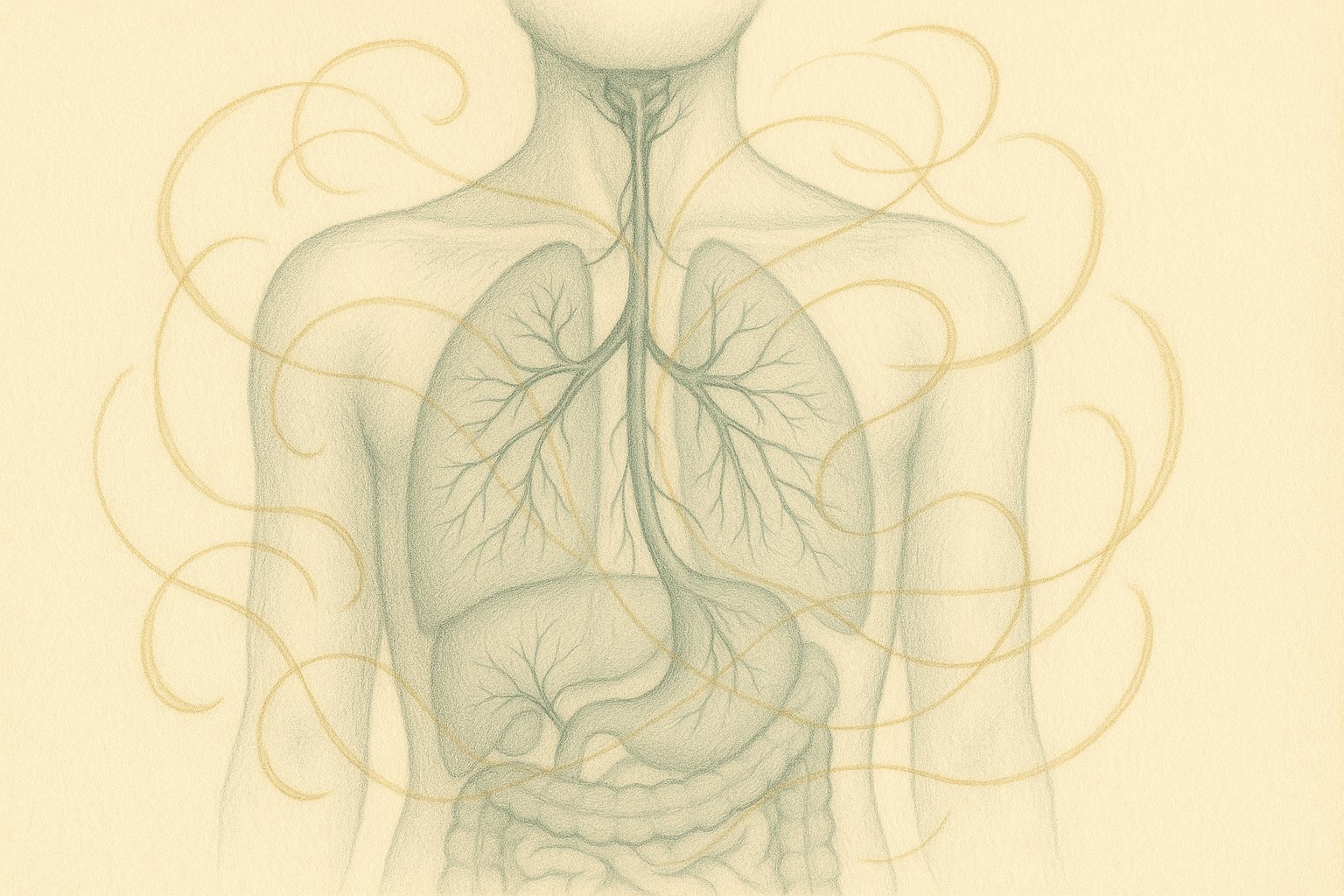
The vagus nerve is the longest cranial nerve in the human body. It connects the brain to the heart, lungs, and intestine. It is what drives the return to calm — when it is toned, it allows you to breathe deeply, digest peacefully, sleep soundly, and feel connected to others.
A weakened vagus nerve means a body that can't calm down even after the danger has passed. This is what is called low vagal tone — associated with a wide range of physical and emotional difficulties. The good news: vagal tone can be trained. Through the body.
How acupuncture regulates the nervous system
Acupuncture stimulates specific points that directly activate the parasympathetic branch of the nervous system. Points like ST36 (Zusanli, on the leg) and PC6 (Neiguan, on the forearm) have been widely studied for their effect on vagal afferents — the nerve pathways that inform the brain about the state of the body.
Over a few sessions, several things begin to shift:
- Vagal tone improves, measurable through heart rate variability
- Heart rate regulation improves
- Cortisol, the stress hormone, decreases
- Sleep reorganizes
- Systemic inflammation decreases
- Emotional reactivity moderates
What the research says
-
Vickers et al. — The Journal of Pain (2018)
A meta-analysis of thousands of patients confirming acupuncture's effect on chronic pain beyond a simple placebo effect.
-
Torres-Rosas et al. — Nature Medicine (2014)
Demonstrates how electroacupuncture at point ST36 activates the vagal pathway and modulates the immune and inflammatory response — a key reference for understanding the physiological mechanism.
-
Hui et al. — Autonomic Neuroscience (2010)
fMRI studies showing how stimulation of acupuncture points modulates the brain's limbic networks — those that govern stress and emotional regulation.
-
Anderson et al. — Explore (2012)
A synthesis on the relationship between acupuncture and heart rate variability, a clinical marker of parasympathetic tone and vagal health.
How many sessions to feel results?
Most people notice a subtle shift after the first or second session — deeper sleep, calmer digestion, a sense of release that's hard to name. The deeper effects, those that durably alter vagal tone, generally build over six to ten closely-spaced sessions, then consolidate through more spaced follow-up.
Every body has its own rhythm. This is why acupuncture treatment is always individualized.
When to come in?
You don't need to be at your breaking point to seek care. Intervening early, when the signals are subtle, is often more effective than waiting for the body to really shout. Acupuncture is particularly indicated for people who:
- Experience chronic stress, anxiety, or sleep difficulties
- Feel a fatigue that doesn't lift even after rest
- Have diffuse physical symptoms that conventional medicine struggles to explain
- Are looking for a body-based approach to complement their therapeutic work
- Want to prevent the shift toward chronicity
Your nervous system is not a technical detail. It is the invisible foundation on which your relationships, your work, your health, and your capacity to live fully are built.