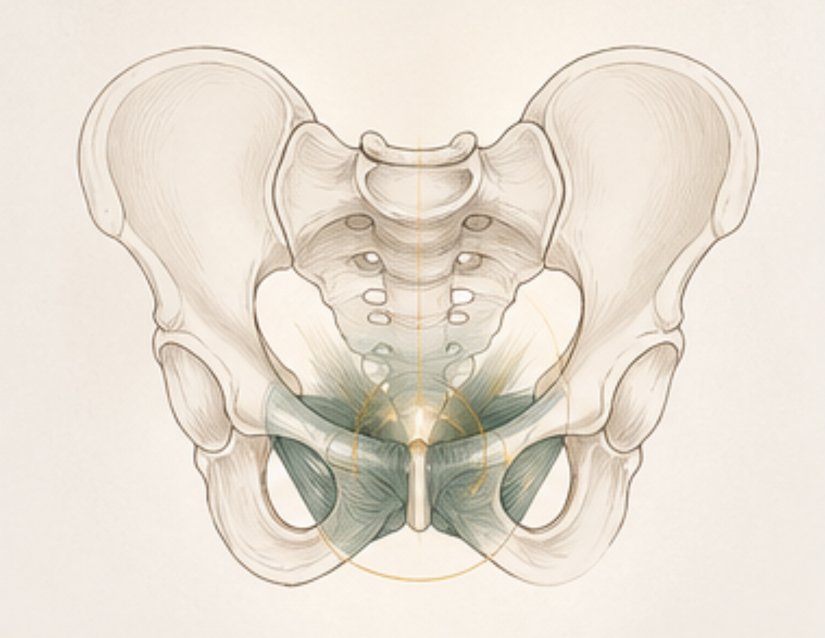
The pelvic floor is one of the most overlooked — and most misunderstood — regions of the human body. Chronic pain, urinary dysfunction, sexual difficulties, unexplained anxiety: many of these symptoms originate in this area that conventional medicine rarely examines closely. Here is what acupuncture can offer.
What the pelvic floor actually is
You may have been told to "do your Kegels." But before jumping to solutions, it is worth understanding what the pelvic floor actually is — and why it deserves this level of attention.
The pelvic floor is a dense, hammock-shaped network of muscles, fascia, and nerves spanning the entire base of the pelvis. Its role extends far beyond urinary continence.
It is the physical and energetic foundation of the body: the base of your breathing, your posture, your reproductive and digestive organs. It is also intimately connected to the autonomic nervous system — the mechanism through which your body registers safety or threat.
In Chinese medicine, this region is a major energetic crossroads: it is where the Kidney and Bladder meridians converge with the Conception Vessel (Ren Mai) and the Penetrating Vessel (Chong Mai) — the deepest reservoirs of constitutional vitality.
Symptoms of pelvic floor dysfunction
Most people associate pelvic floor problems with incontinence. The reality is considerably more varied — and often unrecognized as such.
Urgency, frequency, leakage, sensation of incomplete emptying.
Constipation, straining, hemorrhoids, feeling of incomplete evacuation.
Pain during intercourse, decreased sensation, erectile difficulties, reduced arousal.
Painful periods, endometriosis-related pain, prolapse, postpartum recovery difficulties.
Chronic low back pain, hip pain, sacroiliac instability, coccyx pain.
Chronic anxiety, panic responses, unexplained grief, feeling unsafe in one's body.
If several of these resonate, the connection to the pelvic floor is worth exploring.
Why the pelvic floor holds so much tension
The pelvic floor is one of the body's primary sites of trauma storage. This is not metaphor — it is neurobiology.
This region has particularly dense connections to the vagus nerve and the autonomic nervous system, and plays a central role in the body's emotional processing of safety. Chronic stress, birth trauma, sexual trauma, surgery, persistent pain, or even years of unconscious bracing against perceived danger can all become encoded in pelvic floor dysfunction.
The result is chronic tension, chronic holding, or chronic numbness — often completely invisible to the person experiencing it, until something begins to release.
Why Kegels are not always the answer
The most common advice for pelvic floor dysfunction is to strengthen the muscles through contractions. This recommendation assumes the problem is weakness.
Often, it is the opposite. Many people have a chronically hypertonic pelvic floor — one that is in a state of constant, excessive contraction. Adding more contraction to that pattern makes symptoms worse, not better.
What a hypertonic pelvic floor needs is:
- Release learning to let go of held tension
- Nervous system regulation moving out of sympathetic activation
- Fascial and neurological rebalancing restoring tissue mobility
A functional pelvic floor is not a strong pelvic floor. It is one that can contract and release as needed — with suppleness and intelligence.
How acupuncture works with the pelvic floor
Acupuncture is one of the few therapeutic tools that can address the pelvic floor across multiple dimensions at once — structural, neurological, hormonal, and emotional.
-
Local points and pelvic meridians
Points on the lower abdomen, sacrum, and ankle — along the Ren Mai, Chong Mai, Kidney, and Bladder meridians — release accumulated fascial tension and stimulate blood and energetic circulation throughout the pelvis.
-
Autonomic nervous system regulation
One of acupuncture's most well-documented effects is its action on the nervous system. By shifting physiology from sympathetic activation (alertness, tension) toward parasympathetic response (safety, release), it creates the conditions that allow true pelvic release — impossible while the body remains in survival mode.
-
Auricular points and emotional layers
Auricular points — including those from NADA-style protocols — can address the emotional and traumatic layers often stored in the pelvic region. This approach is particularly relevant when physical symptoms are accompanied by anxiety, mild dissociation, or somatic memory.
-
Constitutional treatment in Chinese medicine
Beyond the symptom, acupuncture reads the full constitutional picture: kidney essence, reproductive health, hormonal regulation. This deeper lens makes it possible to address underlying causes rather than simply quieting alarm signals.
Who this kind of work is for
This approach may be useful for anyone who:
- Has tried strengthening exercises without lasting results
- Experiences chronic pelvic pain without a clear explanation
- Feels tension or discomfort in the pelvic, lumbar, or hip region
- Lives with unexplained digestive, urinary, or sexual symptoms
- Has been through childbirth, pelvic surgery, or physical or emotional trauma
- Feels chronically on alert or disconnected from their body
You do not need a precise diagnosis to begin exploring this.